3 min read
The case for talking to strangers
We put real effort into avoiding strangers. Headphones go in on the bus, eyes stay on the phone in the queue, and the lift gets a polite nod at most.
Over the past decade, social psychologists have measured what that habit costs. Their findings point the same way: we misjudge strangers, and the misjudgement leaves us less happy than we could be.
We are bad forecasters
Most of this research rests on one finding. People predict badly how a conversation with a stranger will go. They expect rejection and awkward silences, and what they usually get is a pleasant few minutes and a better mood.
The commuter study
Nicholas Epley and Juliana Schroeder tested this in 2014 with train and bus commuters in Chicago. Some were asked to start a conversation with a stranger, some to sit in solitude, and the rest to travel as they normally would.
Participants expected talking to be the worst of the three. It turned out the other way round: those who talked reported the most positive journeys. Being turned down, which is what people feared most, was rare.
You were more liked than you think
In 2018, Erica Boothby and colleagues had pairs of strangers talk, then asked each person two questions. How much did you like your partner? And how much do you think your partner liked you? People reliably guessed too low on the second.
The researchers called this the liking gap. We judge ourselves on the stumbles we remember. The other person, busy with doubts of their own, mostly did not notice them.
People want more than small talk
The weather is a safe topic, and that is usually where we stay. A 2022 study by Michael Kardas, Amit Kumar and Nicholas Epley suggests we give up something by doing so. Strangers asked to discuss deep, personal questions found those conversations less awkward and more rewarding than they had expected, and felt more connected afterwards.
We hold back because we assume the other person would rather keep it shallow. They are often assuming the same about us.
The quiet value of weak ties
In 1973 the sociologist Mark Granovetter described the strength of weak ties. Acquaintances connect us to information and opportunities that our close circle cannot, because our close circle mostly knows what we know.
Gillian Sandstrom and Elizabeth Dunn later looked at the emotional side. On days when people had more interactions with weak ties, they felt happier and more connected. A short conversation with someone you will never see again counts for something. It is part of what makes a day feel good.
Why a random chat is a good place to practise
In person, starting a conversation with a stranger carries some social risk. A random chat online removes most of it. Everyone there has chosen to talk, nothing carries over from one conversation to the next, and leaving is expected rather than rude. The person on the other side may also live somewhere, or in a way, you would never come across otherwise.
Habits worth keeping
- Expect it to go well. The evidence is on your side.
- Ask a real question early, then follow up on the answer.
- Say something about yourself too; connection runs both ways.
- Judge it over several conversations, not one.
- Keep anything that identifies you to yourself, and leave when something feels wrong. The safety page has more.
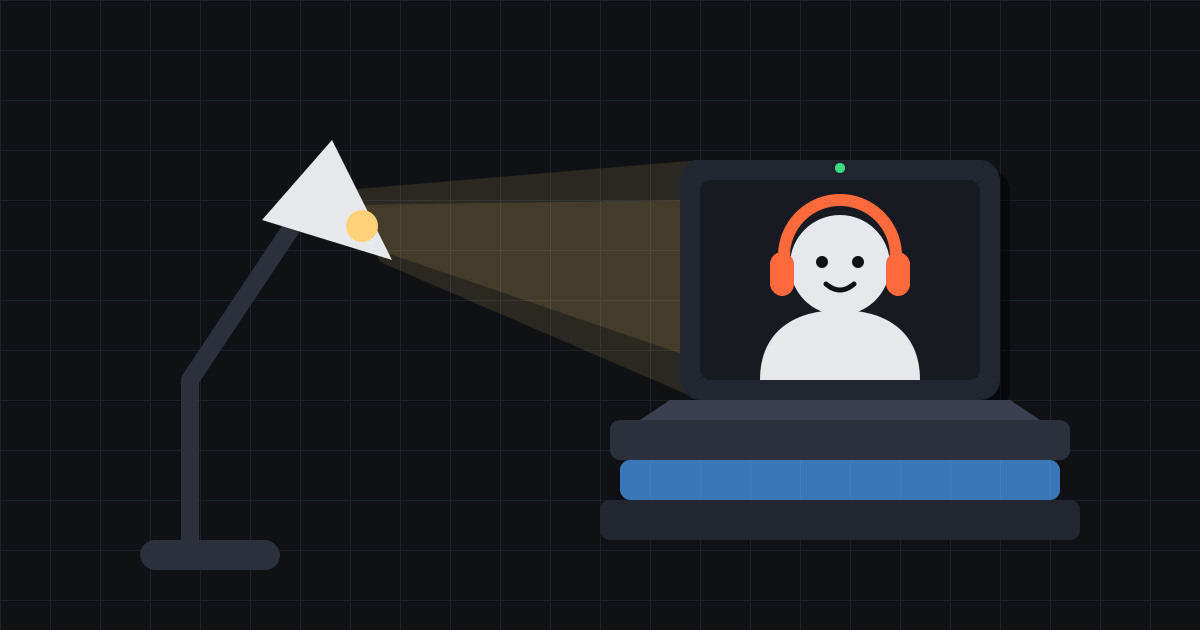
- If you are on camera, small adjustments go a long way. See how to look and sound good on a video chat.
Try it
The research is persuasive. Your own experience is the better test, so meet someone new and compare it with what you expected.